
How to play sudoku: rules, techniques and strategy
Sudoku is a logic puzzle: fill a 9×9 grid so that every row, column and 3×3 box contains the digits 1 to 9 exactly once. You never do arithmetic — you eliminate possibilities until only one digit can fit.
The three rules of sudoku
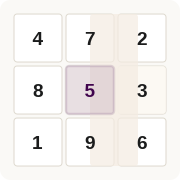
- Rows. Each horizontal line of nine cells holds each digit from 1 to 9 once. No repeats.
- Columns. Each vertical line follows the same rule. A placement eliminates that digit from the entire column.
- Boxes. Each of the nine 3×3 nonets also holds every digit once. Rows, columns and boxes overlap, which is what makes the puzzle interesting.
Given digits are fixed. A correctly constructed puzzle has exactly one solution, so every placement can be proved with logic. That is also how the generator behind sudoku online online works: it removes digits only while the remaining grid still has a single solution.
A six-step method for solving any grid
- Scan one digit at a time. Start at 1 and search the whole grid for every visible copy. Keeping one digit in mind avoids overload.
- Place singles. Fill naked singles (only one candidate for a cell) and hidden singles (only one cell for a digit).
- Refresh your notes. After each placement, delete that digit from the candidate lists in the shared row, column and box.
- Find subsets. Naked pairs, hidden pairs and triples prune several cells at once.
- Use locked candidates. Pointing pairs and box-line reductions remove candidates from whole units.
- Escalate only when needed. X-Wings, Swordfish and chains belong mostly to Expert and Master grids. Verify at the end.
Six techniques every solver should know
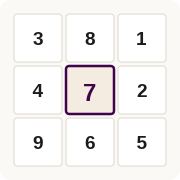
Naked singles
A cell becomes a naked single when eight distinct digits already appear in its row, column or 3×3 box. Only one digit remains legal, so place it immediately. This is the engine of every easy puzzle.
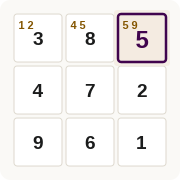
Hidden singles
A hidden single occurs when a digit can go in only one cell of a unit, even though that cell has other candidates. Look at one digit at a time and scan the three boxes of a band or stack.
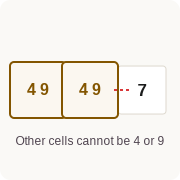
Naked pairs and triples
When two cells in the same unit share the identical candidate pair, those two digits must occupy those cells. Remove both candidates from every other cell in that row, column or box. The same logic extends to triples.
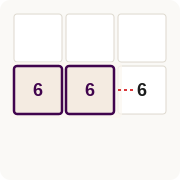
Pointing pairs and box-line reduction
If all candidates for a digit inside a 3×3 box lie in one row, that digit must be in that row — so remove it from the rest of the row. The reverse is box-line reduction: candidates aligned in a row or column confine the digit to one box.
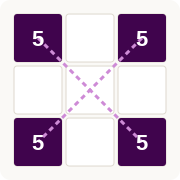
X-Wing
When a digit has exactly two candidate cells in each of two rows, and those candidates share the same two columns, they form a rectangle. That digit can be eliminated from every other cell in the two columns.
Swordfish and chains
A Swordfish extends the X-Wing idea across three rows and columns. Chains follow alternating candidate relationships until a contradiction proves a placement. Both demand careful notes and patience rather than luck.
Sudoku difficulty, explained
| Level | Givens | Typical techniques |
|---|---|---|
| Easy | ~42 | Scanning, naked singles |
| Medium | ~36 | Hidden singles, cross-hatching |
| Hard | ~31 | Pairs, triples, candidate cleanup |
| Expert | ~27 | Locked candidates, X-Wings |
| Master | ~24 | Fish patterns, chains |
Play a free puzzle at any level →
A short history of sudoku
The modern number-placement puzzle was created in 1979 by American architect Howard Garns and published by Dell Magazines under the name Number Place. Japanese publisher Nikoli introduced it in 1984 as sudoku — a shortened form of a phrase meaning “single numbers” — and refined the clue symmetry and uniqueness rules that solvers expect today. The puzzle reached a global audience after The Times began publishing it in 2004.
Primary references: Nikoli’s official sudoku page and the Wikipedia history of sudoku.
Sudoku questions, answered
What are the three rules of sudoku? +
Each row, each column and each 3×3 box must contain the digits 1 through 9 exactly once. Given digits cannot be changed, and every valid puzzle has a single unique solution.
Does sudoku require maths? +
No. Sudoku uses digits as nine distinct symbols; you never add, subtract or calculate. It is a logic and pattern-recognition puzzle.
What should I do when I get stuck? +
Rescan one digit at a time from 1 to 9, refresh your pencil notes after every placement, then check for naked singles, hidden singles and locked candidates before considering advanced patterns.
Is guessing ever necessary? +
No. A well-constructed sudoku can be solved with logic alone. Every puzzle generated on Sudoku Online Online is verified to have exactly one solution.
How long does a sudoku take? +
Easy grids often take 5–10 minutes, Medium 10–20, Hard 20–35 and Expert 35–60. Master puzzles can take over an hour. Regular practice shortens those times.
Who invented sudoku? +
American architect Howard Garns created the modern puzzle in 1979, published as “Number Place” by Dell Magazines. Japanese publisher Nikoli introduced the name “sudoku” in 1984, and The Times brought it to worldwide attention in 2004.